






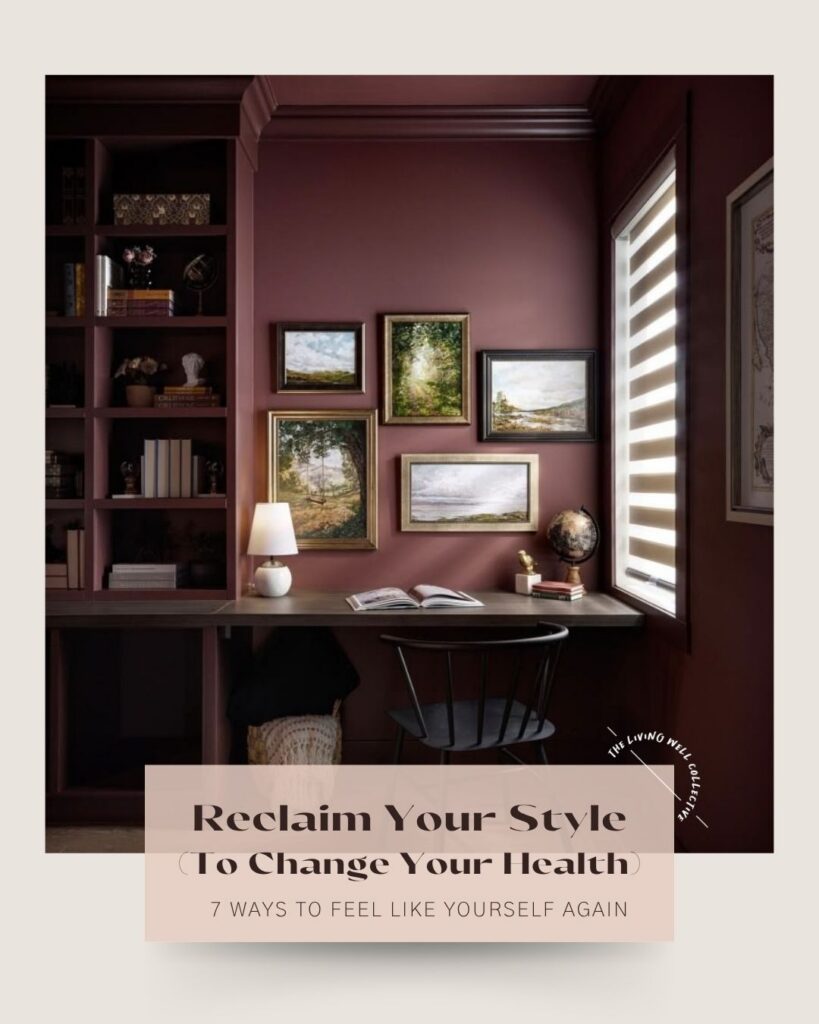
I can’t tell you I’m the most stylish person you’ll ever meet. I’m much more comfortable designing a room than I am dressing myself. And while that might sound backward, I think the two are more connected than most people realize.
Styling my home just feels easier, partially because it’s private. It’s an expression of myself that the world doesn’t get to judge. My clothes on my body? That’s a completely different story. And yet, regardless of how “stylish” you consider yourself, there is real value in style. And I’m not talking about vanity or trying to look a certain way. But “style” in the form of creativity actually influences your health.
Your style is a form of expression that impacts your wholeness – mind, body, and soul. Creativity is literally how we, especially as women, express ourselves. But it’s also more than that. It’s about your vitality.
I think this is partially why our collective sense of style has quietly declined. Style through the decades gives us a glimpse into more than fashion. It’s a mirror of our health, in every sense of the word. A loss of style and creativity signals a loss of vitality.
Over time, it could be why we’ve drifted toward a life with less color, fewer design elements, limited patterns, and less creativity overall. It’s time to reclaim that. To bring back style, creativity, and maybe even create your own personal brand. Not just because it changes your health, but it also changes how you show up in the world.
Why style is a health habit, not a vanity project.
Again, style isn’t about vanity. It’s more about shifting how you show up in the world based on your biology. Your nervous system reads your environment (including what you wear and how your home feels) as a sign of safety. That’s why reclaiming color and creativity is a legitimate act of self-care.
Daisy Fancourt, author of Art Cure: The Science of How the Arts Save Lives, calls the arts “the forgotten fifth pillar of health.” Alongside diet, sleep, exercise, and nature. Her research argues the arts aren’t a luxury; they’re essential to how our bodies and minds function.
Research backs this up. A 2024 study published in the Journal of Macro Marketing followed 252 UK women ages 38-67. They found women who felt satisfied with their clothing choices reported better overall well-being and more optimism about their future. Women who liked what they wore were less likely to skip social events, which kept them connected. They were more likely to engage with others, and this connection protected their mood.

Finding your style
I know it’s easy to turn up your nose at just the word “style.” Because style has quickly become a form of mimicry. But your style doesn’t have to look like everyone else’s. The key is that it’s your style. I think part of the frustration with uncovering your own unique style is attempting to attach ourselves to someone else’s style instead of building our own. Mimicking what we see or what we’ve been told is “stylish” instead of owning what’s actually ours.
Let me remind you: only you get to decide what your style is. It’s okay if it doesn’t match what the world says looks good. Who knows, you may be a trendsetter. The goal is not to be Pinterest-worthy, even if you find inspiration there. It’s to let your style feel like an expression of you. A sign of vitality.
I will, however, give you one nudge. Mix in some color. Don’t get stuck in black and white. Even if it’s an accent color in your home or a simple accessory, start to experiment with a bit of color.

7 Ways to Reclaim Your Style
01. Give yourself permission to get messy
Give yourself permission to be imperfect. I know it’s tempting to compare yourself to perfectly curated homes and closets and assume it’s out of reach. But the best style, like the best art, comes with a bit of experimentation. Use the “mess” and build on it. Don’t quit the first time it doesn’t feel right. That’s the nature of style; you have to try it on and keep trying it on until you find what feels good.
Try it out: Pick one thing, an outfit, or a shelf or tabletop and let yourself experiment without needing to be “right” the first time.
02. Get inspired
This can be tricky, because being inspired means looking around and noticing what lights you up. What you call beautiful. All without attaching yourself to it. Let the beauty of the world inspire you. That could be spending more time in nature, trying a new restaurant, buying a magazine, following blogs or social accounts that inspire you. Use these things not to follow or compare yourself to, but to inspire creativity for you to create your own way.
Note: Inspiration and mimicry both start the same way. By noticing something outside yourself. Where it splits is what you choose to do with that response. Inspiration uses what you notice as a spark, not a template. It’s something that lights you up, but it’s ultimately filtered through your own taste. It accentuates more of you. Mimicry skips the filtering. Instead, you attempt to reproduce it as closely as possible, without asking, does this actually fit you?
Try it out: Create a Pinterest board, or mood board with images, places, outfits, home decor that genuinely makes you feel something. Not the ones you think you’re “supposed” to like. Notice patterns, filter it through your own being, and use it to build what is fully you.
03. Use What’s Already Around You
Most people stop before they get started because they don’t think they have the budget to work on their style. I get it. I don’t buy a lot of new clothes, and I’m particular about what decor I buy for my home. I’m a master at getting home decor on sale.
At the same time, there are still plenty of ways to get creative and create a style without spending lots of money (if any at all). Start by getting familiar with what you already have, then get creative with how you style it differently. That could mean laying shirts in a different pattern or trying them with different pants. At home, it could look like moving furniture around in your house, adding layers with what you already have. Don’t let the cost be a reason you don’t start. You probably already have what you need to get started.
Try it out: Restyle one current outfit with a different accessory or layer. Or try moving art to a new wall, and digging through your backroom to see what pieces you have tucked away that you could use again.
04. Let go of it needing to make sense
One of the things I’ve released in my own home is the need for everything to make sense. In fact, I think it not making sense is what makes it make sense. Your home doesn’t need to be perfectly curated and coordinated to work. It’s easy to get lost in the process instead of trusting what you want. Don’t get so caught up in curation that you miss building layers. You might be surprised that what logically doesn’t work produces the most captivating spaces.
And if it doesn’t end up working, you can try something different (step six).
Try it out: Notice one place you’re editing yourself attempting to make it “make sense,” and let it be a little illogical instead.
05. Try It on
At some point, you just have to do it. Wear the outfit, try the new shirt, paint the wall a color and see how it feels. Try it on for a while and test it out. You don’t know what you don’t know. And even if you liked it on the rack or in the magazine, it doesn’t mean you like it for you. I like a lot of things for other people that I don’t prefer myself. That doesn’t mean they’re right or wrong, good or bad, but it’s just not me. That’s okay. Try something different and keep trying until you find what works for you.
Try it out: Try something different, a little unexpected, that you’ve been inspired by. Don’t judge it, but just notice it and build from there. It could be a new way to wear the outfit, like denim on denim, or a full monochromatic home look. Take something for a test run and see how it fits.
06. Edit It
If it doesn’t work, remember, you can always edit it. You can change the outfit, donate the shoes, or repaint the walls. It might not be ideal, but stop seeing it as a loss and start seeing it as progress. Because here’s the reality: everything is always progression. I wouldn’t choose the style of my first house again, and yet, I felt good about it then. What worked in one season might not work in another, and that’s the beauty of art. It’s layers, evolution, and experience. Trust the process, the changes, and all the iterations. You can always change it again.
Try it out: Allow yourself to let go of one thing, a piece of clothing or a decor item, that no longer fits who you are. When you create space by releasing what isn’t working, you can open up space to get creative with a different option.
07. Settle into the process
Style isn’t a project you finish once and check off. It’s a practice, a process, a journey, like all things that keep you healthy. The version of you a year from now might decide you want something different. That’s the whole point. Come back to these steps whenever your style starts to feel like it’s on autopilot instead of like you.
Try it out: Circle back to step one in three months and notice what’s already shifted.
FAQ: Reclaiming Your Personal Style
Yes, and it’s backed by research, not just a feeling. Do your own experiment. Put on an outfit that makes you feel good. Something that you feel confident in. Then go out and spend your day. Notice how you felt? Do the same thing with an outfit that makes you insecure. Do you notice a difference? You are your best information. Try it out for yourself and be the living proof you need.
Start with what you already own. Restyle one piece in a new way (you could use a scarf as a belt, or move art to a different wall) before you buy anything new. Reclaiming your style is about creative permission, not a shopping list (see #3 above).
Start noticing instead of deciding. Save five images, outfits, or spaces that genuinely make you feel something, without asking whether they’re “supposed” to be your taste. Patterns will show up faster than you expect. That’s inspiration you can use to start developing and pulling out what you like.
Absolutely not! As mentioned, this is a never-ending process. A journey that life takes you on regardless of your age. If anything, this is the season it matters most. Psychologists note that middle age is a particularly vulnerable stretch for women, and clothing that feels both well-fitting and appropriate for this season of life is tied to better mental health.
That’s not failure. That’s information you can use. In fact, I’d like to throw out that there is no “failing” in discovering your personal style. All information is good information, even if you didn’t like it at the time. The key is trying something on, taking it for a test run, and finding out what’s actually you versus what just looked good on someone else. If it doesn’t work, you edit it: donate it, repaint it, move on. Nothing has to be permanent.
No! And that’s the whole point. It isn’t to be Pinterest-worthy. It’s to feel like an expression of you. Copying someone else’s style (mimicking) is different from letting it inspire your own. Only you get to decide what your style actually is.A Simple Guide to Reclaim Your Style at Any Age
This post contains an affiliate link. If you purchase through it, I may earn a small commission at no cost to you.