






Roughly ten years ago, I had a massive life crisis. I lost my health while doing everything right.
I’m still not sure whether the fall was more about the pain of trying so hard and ending up worse than I started, or the pride of working in a health space I apparently knew nothing about.
Of course, there were a lot of things at play. And somewhere in the middle of it, I started to realize I didn’t even know who I was. I had been chasing ideas, places, and situations the world told me I needed to be, do, and become, with little regard for who I really was.
I did the work, but I expected the fix.
I’ll be forever grateful for my counseling experience. But the point of therapy didn’t really land until my last therapist.
Yes, I fired the first three, for reasons you may be familiar with. They weren’t giving me what I wanted. Which was a completely new story. I did the work, but I expected the fix. And truthfully, I didn’t know they weren’t in charge of my fix. I was.
I hope that lands as hard for you as it did for me. If we’re ever going to be different, live differently, or transform in whatever area we’re longing for, the most important thing is self-responsibility.
Our healing is ultimately up to us. I see this play out all through the Bible. The people who received healing and miracles sought them out. The woman who pressed through the crowd to touch the hem of Jesus’ garment. Blind Bartimaeus, who kept shouting even when people told him to be quiet. The friends who lowered a paralyzed man through a roof. They didn’t sit back and wait, and they didn’t put it on someone else. They wanted it, they chose it, and they believed it.
One of my favorite examples is a woman whose whole story changed in a single conversation at a well. I unpack her in Four Lessons from the Woman at the Well.
If you’ve ever waited on someone else to hand you the fix, today’s podcast is for you. I go deeper into what finally shifted for me in that fourth counselor’s office, why self-responsibility is the first step in changing your story, and how to stop outsourcing your healing without carrying it all alone. Grab your coffee, press play, and let me show you how to rewrite your story.
The story that’s running your life
When I look at the wider health and wellness space, from mental health all the way to soul care, I see one common theme. I lived it too.
Most of us are living out of the worst thing that happened to us, or the things we hate most about ourselves. We’re literally allowing them to be the theme of our story.
And when those become our story, we hand them control of our lives.
That’s the power of story. It’s not a fairy tale. It’s running the show. Our stories are one of the most influential forces shaping who we become, often without us ever noticing we’re telling one.
As James Kerr puts it: “Our words shape our story and our story becomes the framework of our behaviors.”
Tim Keller taught something similar: “We all live out of a core narrative, and that story dictates our beliefs, our desires, and our daily actions.”
I’ve seen this most clearly with our health. If you want to see how the stories we tell about our bodies become self-fulfilling, read Are You Dramatizing Health? Rewriting Your Health Story.
You are not the worst thing about you.
If you believe this, let me remind you. You are not the worst thing that happened to you or the worst thing about you. This is why I’ve become so passionate about story work and the transformative power of editing the story.
In my opinion, that is exactly the work of Jesus. He reminds us we aren’t the worst thing that happened to us, and we’re not the worst thing about ourselves. We’re so much more.
We don’t have to keep living out of it. Living out of the worst parts of us only fuels them to keep controlling our lives. And nobody wants that. You were made for more than that.
But when you go back and edit the story, your life unfolds accordingly. You can walk away from the things you hate. The things that distract you from living God’s plan for your life. And step into who you were made to be.
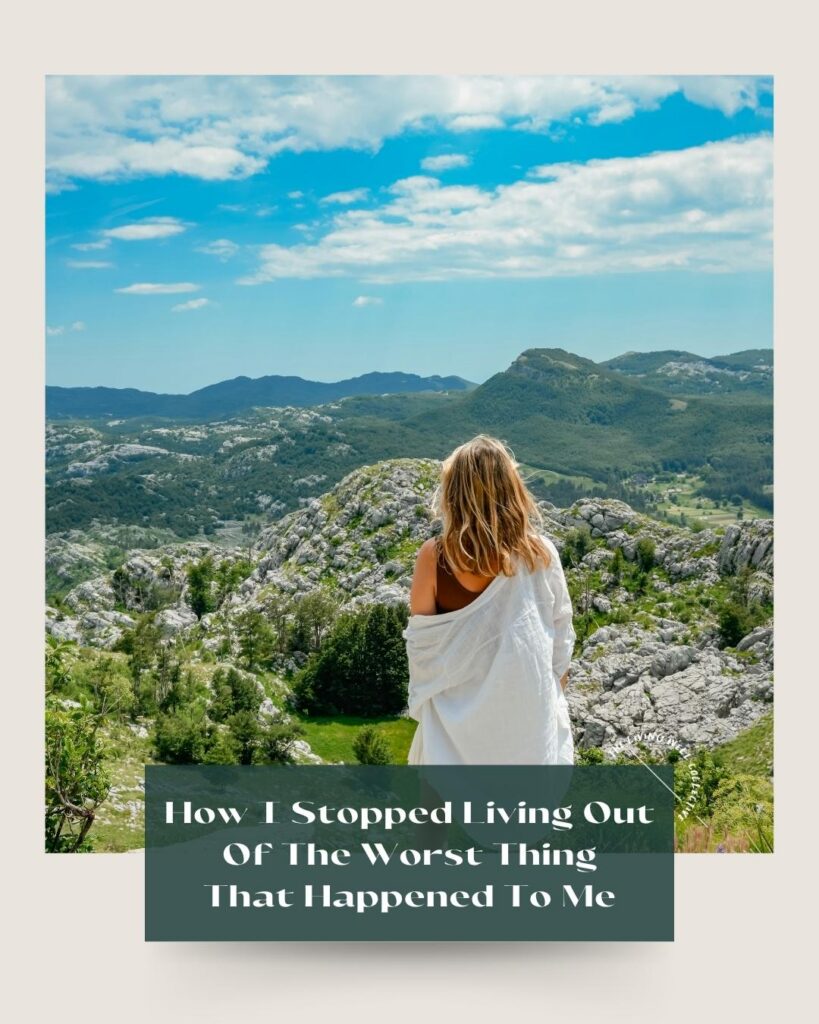
How I stopped living out of the worst thing that happened to me & learned how to rewrite my story.
01. I understood the story I had built around it
You can’t edit a story you haven’t read. You might have repeated it a thousand times in any given day, but that doesn’t mean you know it. That’s why the first step is honesty about what you’ve been telling yourself.
Mine went something like: I did everything right and it still fell apart, so I can’t trust myself, my body, or the things I thought I knew. That story had quietly become the lens for everything: my work, my relationships, even my faith. To the point where I literally thought I was cursed.
Ask yourself: What is the story of the worst thing that happened to me? Or what story do I tell about the worst thing about me? Write it out, as plainly as you’d say it on your hardest day.
02. I changed the perspective and put God in the story
For most of my life, I let the worst thing that happened to me (and the things I hated about myself) be the main character, the narrator, and the judge of my story. I literally handed my life over to the things I hated and let them create the evidence that this was all there was to my life.
But when I invited God into the story, the question changed from “What’s wrong with me?” to “What is He doing here, and who does He say I am?” Joseph said it best to the brothers who sold him: “You intended to harm me, but God intended it for good” (Genesis 50:20). The event didn’t change. The author of its meaning did. And that’s a really important distinction!
For an everyday version of this shift, see The Little Things Aren’t So Little (A Faith-Rooted Reframe).
Ask yourself: Where was God in this chapter? What might He be writing that I can’t see yet?
03. I created a new view
Once God was in the story, I needed a new lens to see myself through. Not a positive-thinking slogan, but what’s true. Loved. Chosen. Being made new (2 Corinthians 5:17). Someone whose worst moment is a chapter, not the title.
This new view isn’t only spiritual. It shows up in your body, too. More on that in (Holy) Confidence Changes Your Biology.
Ask yourself: If I believed what God says about me, how would I describe myself? Write that down as your new view.
04. I filtered the old story through the new view and revised it
This is the editing. I took the old sentence from Step 1 and ran it through the new view. “I did everything right, and it fell apart, so I can’t trust myself” became “Losing my health taught me who I am apart from what I do, and it led me to the work I was made for.” Same facts, different meaning, different direction.
Ask yourself: Rewrite your Step 1 sentence through your new view. What stays true? What was never true to begin with?
05. I created new evidence
A new story needs proof, or the old one creeps back in. So I started living in small ways that matched the revised story: choices, boundaries, habits, and conversations that only the new version of me would make. Every one became evidence. Over time, the evidence outweighed the old narrative.
Ask yourself: What is one small action this week that the new-story version of me would take?
What is the evidence of your life showing?
Look at your week: your choices, your reactions, the way you talk to yourself. That’s the evidence. It is either supporting the old story, propping up the worst things about you, or the new story. It will tell you which story you’re living out of right now.
If it’s pointing back to the worst thing that happened to you, that’s not a verdict. It’s an invitation to edit.
Curious about your story?
Listen to today’s podcast for all the details on story change, including how to spot the story you’re living out of and start rewriting it.
Join the Freedom Story workshop. It’s exactly the plot twist your story needs to change where you’re headed. Together we’ll walk through all five steps, so you leave with a revised story and a plan to build new evidence. [Sign up here]
You are not the worst thing that happened to you. Let’s go write what’s next.