



Last spring, I came to the quiet but startling realization that my body was bored.
It’s ironic to say because my life felt anything but boring. I would have welcomed some boredom into my life. Yet, my body was bored. It had energy that needed to burn, and I wasn’t giving it anywhere to go.
I only recognized this because of a study I was doing on the connection between mental and physical energy. And one thing the body teaches you, if you pay attention, is that it’s not always responding to your enviornment the same way your mind does. You can be mentally depleted and emotionally wrung out, all while your body is sitting on a full tank of unspent energy.
Most of us miss this completely. It’s easy to. You fight the mental and emotional exhaustion so hard that you assume that your body is exhausted. But you rarely stop to ask: Is my body actually tired, or just my mind?
The imbalance between mental and physical energy is one of the most overlooked causes of sleep problems, anxiety, and that unsettled, restless feeling so many of us chalk up to stress. We assume the answer is more rest. But when your body still has energy, and when it’s been under-challenged for a long time, rest isn’t the solution. Movement is.
Like everything in your biology, your body works to maintain balance. Your physical energy needs to match your mental energy. When it doesn’t, things start to break down in ways that are hard to name but impossible to ignore.
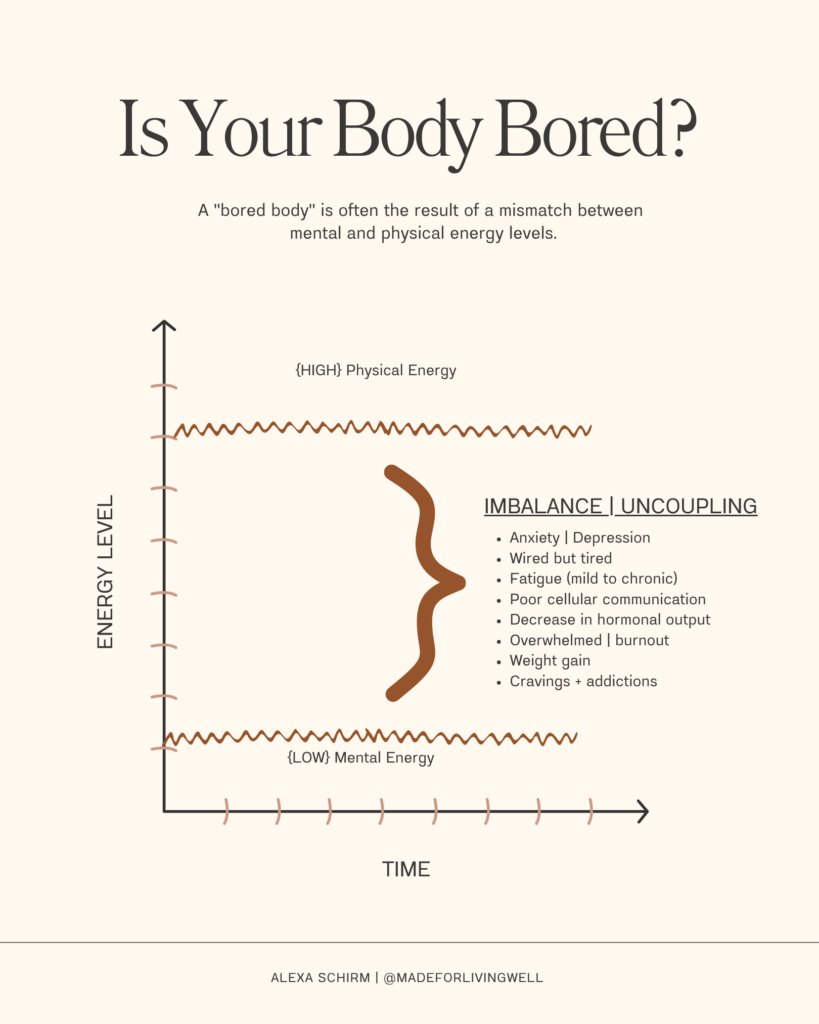
I was living in that imbalance. My mind was completely exhausted, leaving me with what I perceived as zero energy to move my body. Yet, my body was bored, which only amplified my emotional exhaustion. When I learned the answer wasn’t to pull back, but to move to recreate balance, things really started to change. That’s when I started to really understand the value of walking and why I think you should too.
Why I Chose Walking (And what I actually expected)
I’ve always loved walking, but for most of my life, running was my thing. I wasn’t necessarily in love with the act of running. I was in love with the runner’s high. That post-run feeling of clarity and release got me through many things.
Honestly, I never thought walking could come close. It seemed too easy. Too gentle. Too insignificant to matter. At the time, I had a very strong belief that “no pain meant no gain.” Which made walking feel like I was settling for the easy. It wasn’t hard enough to work.
But after starting my own healing journey and recognizing that running had actually contributed to my burnout, I started asking different questions. Was running truly better, or just harder? And did harder mean it worked better? Or was it harder even the point?
Was running really better than walking?
What I discovered is that comparing running to walking is like comparing apples to oranges. They’re different but both nutritious. The comparison was never really about which was better. The most important thing was doing it. It was moving.
Regardless of the intensity I would set, I decided to try something different. I focused on steps.
Last summer, I began tracking my steps. When I started, I was averaging 10,000-12,000 steps most days. I decided to push a little harder (backing up that old belief) and aim for 20,000 steps a day. I wanted to know if more steps would really make a difference, or if I would just burn out chasing a number?
Here’s what I found after 90 days.
01: Walking 15,000-20,000 Requires Intention (But it’s also more doable than you think)
Let me be upfront: I didn’t hit 20,000 steps every single day. My average over the 90 days was around 16,500. Some days I pushed to 20,000. Other days, my body asked for less, and I listened (more on that in a moment).
What surprised me most wasn’t the physical effort. It was how much the challenge confronted my priorities.
Every Sunday, I’d look at my screen time and feel a little sick. The hours I was spending scrolling weren’t just wasted, they were available. I did the math based on my daily average screen time and realized I could walk several miles in half that time and still have time left over. Honestly, time was never actually the problem. It was where I was putting it.
It’s why I say, you don’t have a consistency problem. You’re always being consistent in something. The question is, are you happy about what you’re being consistent in?
While I’m not a fan of massive behavior overhauls, they’re rarely sustainable. I did decide to be intentional about building steps into my day. I learned that one longer walk of at least four miles became my anchor. This took roughly an hour and ten minutes. The rest I found in small pockets throughout the day:
- Walking around the block a few extra times at school pickup
- Taking ten minutes over lunch to walk the dog
- Doing more household chores (you’d be surprised how many steps vacuuming gets you)
- Dropping my kids off at activities and using that time to walk instead of sitting in my car
None of it was glamorous. Yet, all of it added up.
02: My Appetite Changed in Ways I Didn’t Expect
This was the most shocking result of the entire 90 days, and the one I keep coming back to.
After about a week, I noticed I wasn’t as hungry. Not in a depleted, undereating way. In a regulated way. My cravings quieted. I needed less food to feel satisfied. I wasn’t white-knuckling my way through cravings. They were just smaller, less intense.
It was a new experience, as a runner, I felt like my hunger had picked up.
The science behind this comes down to leptin, a hormone that regulates hunger, energy balance, and metabolism. When leptin is working well, it signals your brain that you have plenty of energy and don’t need to eat more, reducing hunger and boosting metabolic function. When leptin is disrupted (through poor sleep, yo-yo dieting, or too much or too little exercise), the whole system goes haywire.
Here’s the key distinction between walking and other forms of exercise: running and many high-intensity workouts deplete leptin and leave you ravenous afterward. Walking, because it adds energy rather than draining it, is one of the few forms of movement that actually support leptin balance rather than disrupt it.
I experienced this directly. By the end of the challenge, I had more appetite control than I’ve had in years. And not through restriction but through regulation.
03: My Emotional Stability Improved Significantly
I’ll be honest, this experiment became one of the best summers I’ve had mentally and emotionally in a long time. It was no coincidence that it also happened to be the months when I was intentionally walking 15,000–20,000 steps a day.
Walking has long been recognized as one of the most effective tools for nervous system regulation. It creates a kind of equilibrium between your mind and body. One that’s hard to replicate any other way.
Personally, I noticed that most of it was due to how walking was building my capacity, whether through more energy or space to process. I was able to move from reacting to responding better than I ever had. In the process, I was able to have hard conversations without losing my footing. When I did get dysregulated, I came back to center faster. And things that normally would have spiraled me didn’t.
There’s a quote I heard that has stuck with me: “The reason you don’t have energy to work out is because you don’t work out.” It sounds backward, but it’s true. Energy is a byproduct of movement. And when you have energy, you have more control over your emotions, your choices, and your day.
Walking gave me that.
04: My Body Needed Rest (And That Was Part of the Point)
Even though walking isn’t an intense stressor, it’s still work. And work always requires recovery.
I noticed it around the halfway point, about 40 days in, my body was asking for a break. Not a dramatic crash, just a quiet, persistent signal that it needed one day to step back and simply live without tracking.
But I need to note that this desire for rest was different from the emotional burnout. It wasn’t coming from my mind but my body. And it happened in little signals, like tired legs, physically falling asleep quickly, but having more difficulty waking up. All signs my body was tired.
In the earlier weeks, I pushed through that signal. Old habits die hard. But I recognized the pattern and the drive to meet the goal at the expense of listening to my body. Instead, I chose differently.
Once I started honoring one rest day per week, everything shifted. I came back more motivated, more energized, and more consistent. The break wasn’t a setback. It was part of the work.
IMPORTANT NOTE: Just as movement produces energy, so does rest. The goal isn’t constant output. It’s the rhythm between the two.
05: Walking Gave Me More Time Than It Took
As mentioned earlier, when I started, I was afraid of what I’d have to sacrifice to make this work. That fear of time is real for most people. Unfortunately, it keeps a lot of us from even trying.
But what I discovered is that some activities take time, and some make time. Walking is the latter.
Think of it like batch cooking. Yes, spending two hours on Sunday prepping meals takes time, but it gives you four to six hours back during the week. The investment returns more than it costs.
Walking worked the same way. The time I spent on those longer walks paid dividends in focus, productivity, and mental clarity throughout the rest of my day. I got more done in less time because I was operating from a fuller, more regulated state.
The walk also became one of the most intentional parts of my day. I’d listen to sermons or audiobooks, and other times, I’d just offer space to think. In all situations, walking wasn’t a time waste, it became a massive time gain in my life.
The Bigger Question This Challenge Asked Me
Beyond all the physical and emotional findings, this challenge quietly asked me something I wasn’t prepared for: Is what I’m doing worth what it’s giving?
That question has stayed with me. It applies to screen time, yes, but also to so many other places I was spending energy without return.
I want to live a life with purpose. But that requires showing up on purpose in every part of my life. It requires paying attention to how I’m filling my days and honestly evaluating whether it’s adding to me or taking from me.
Walking has added to me in every way, which is why I’ve kept it up for over a year. I’m not focused on hitting the 15,000-20,000 steps consistently, but I am moving consistently in a way that fills me.
My Challenge to You
My challenge to you is to take your current daily step average and add 2,000–4,000 steps for one week. That’s it. Don’t overhaul your life. Just add a little more movement and see what it gives back.
Really pay attention and notice how your mind and body come back into balance.
Leave a comment and let me know if you’re taking the challenge, and fill me in on how it goes.
Ready to Make This Your Summer? Join the Walking Club.
If this post lit something up in you, I want to invite you into something bigger.
The Summer Walking Club kicks off June 1st! It’s three full months (June 1–August 31) of showing up, logging steps, and doing it alongside a community of women who are done starting over.
This isn’t your average step challenge.
There’s no guilt for missing a day. No starting over. No pressure. Just you, your shoes, and a simple, faithful practice that has the power to change everything.
Here’s what’s waiting for you inside:
- A daily walking goal — you set it, we help you meet it
- 14 weekly lessons delivered every Saturday, covering nervous system regulation, identity, consistency, joy, and more
- A private community hosted on Circle — because you were never meant to do this alone
- Live check-ins and guest expert calls throughout the summer
- Weekly challenges and prizes — weighted vests, step trackers, cash prizes, and more
- A Walking Club t-shirt (watermelon or jade green — you pick!) included with every registration
- The first 100 members get an exclusive swag bag
Join the Summer Walking Club Here!
The return on this investment is a regulated nervous system, a consistent habit, and a summer that actually changes you. That’s worth every penny. Not to mention, it’s less than a tank of gas a month.
Come walk with us. Your future self will thank you.