








The mind is wildly powerful in a number of ways. It can be wildly wonderful and wildly reckless. Wildly creative and wildly dangerous. At the same time, it can also be wildly misleading and a poor representation of who you actually are.
It can sway you and lead you to do things you don’t want to do, while justifying and manipulating situations to get what it thinks it needs. But it can also encourage you to step out, be honest, take risks, and go into the hard places that lead to growth.
The version you get daily can feel like flipping a coin. You don’t always know what you’re going to get, and you aren’t always prepared for it.
Truthfully, I don’t believe people will themselves into “bad thoughts” or poor thinking. I don’t think anyone willingly chooses to spend their days isolated in their own minds, spiraling in anxiety or self-doubt.
At the same time, I also don’t think people realize how much power they have to shift their minds and how that shift can change their entire reality. But it doesn’t happen by trying to think yourself well. It happens by changing your experience.
But, before that can happen, there’s something important to understand: Your brain isn’t always telling you the truth.
Your Brain Is Spamming You
Your brain doesn’t operate purely on truth. It runs on programs, patterns, and stories. And when those stories go unchecked, or you’re subscribed to programming that doesn’t fit, they create what I call brain spam.
Brain spam is similar to the junk that ends up in your email inbox. Messages that are unsolicited, misleading, suspicious, or completely out of character. They don’t reflect who you truly are, but they still demand your attention.
Spammy thoughts often feel:
- Uninvited
- Triggering
- Harsh or exaggerated
- Familiar, even when untrue
- Emotionally charged
If we let our brain spam us long enough, it will start shaping our lived experience. That’s because your mind generates your actions, and your actions create your life.
Brain spam is anything untrue, unhealthy, or misaligned with your purpose. These messages usually override rational thought in the name of “protection.” But instead of helping, they quietly chip away at your sense of safety, confidence, and well-being.
Like email spam, it creates unnecessary anxiety, false alarms, and reactions that don’t actually serve you. Not to mention, it wastes precious space and energy on what, truthfully, deserves no attention.
What brain spam sounds like
Your brain “spams” you by pushing receptive or inaccurate information into your awareness, often using survival-based shortcuts that don’t match your reality.
Common examples include:
- Catastrophic thinking
- Intrusive thoughts
- Emotional overreactions that disrupt focus and stability
They are thoughts like:
- You’re bad
- You’re not capable
- Your body is the problem
- You don’t have what it takes
In health, it can also show up as:
- Health anxiety or jumping to worst-case scenarios at the first sign of a symptom.
- Craving comfort or numbing behaviors when you’re overwhelmed, even when they don’t actually help.
- Persistent negative thoughts about your body and what it can or can’t do.
Over time, this fills your mind and creates a disconnection from yourself. It forms an inauthentic, almost counterfeit version of you that is shaped by fear, not truth.
Why does your brain spam you?
I spent many years in therapy, knowing that the stories and thoughts running my life were also ruining it. Yet at the same time, I assumed that if I could just talk myself into a different story and speak repeated gratitude over my life, that things would change.
When they didn’t, I was immensely frustrated, while silently assuming it was just a me problem.
It wasn’t until I started learning why my brain was working the way that it was that I learned why you can’t just think yourself healthy.
Your brain doesn’t spam you without reason.
There is always a purpose, often driven by survival.
Your brain is constantly scanning your environment for threats, patterns, and familiar stories. Most information gets filtered out automatically, without your awareness. What captures your awareness usually relates to safety, memory, or past experience.
This is also how emotions are processed. Emotions are part of your story and lived experience. They’re one of the most human aspects of who you are.
Under normal circumstances, your brain sorts information well. Some goes into the “primary inbox,” some is saved for later, and some should be marked as junk and deleted. But when your brain is overwhelmed, exhausted, or under-resourced, the system breaks down. Spam starts landing in the primary inbox. The more spam you are presented with, the more familiar it becomes until it eventually starts to feel like the truth.
This is why what you expose yourself to matters. You can become so desensitized to the spam that it becomes your reality.
Now, on some level, your brain is always filtering spam and sometimes focusing on it. Every person is going to have spammy thoughts. But with a resourced body, you can quickly determine whether something is spam and delete it.
The Stories Running Your Life
To keep going with the email analogy, spam increases the more places you give your information to — especially the insecure ones.
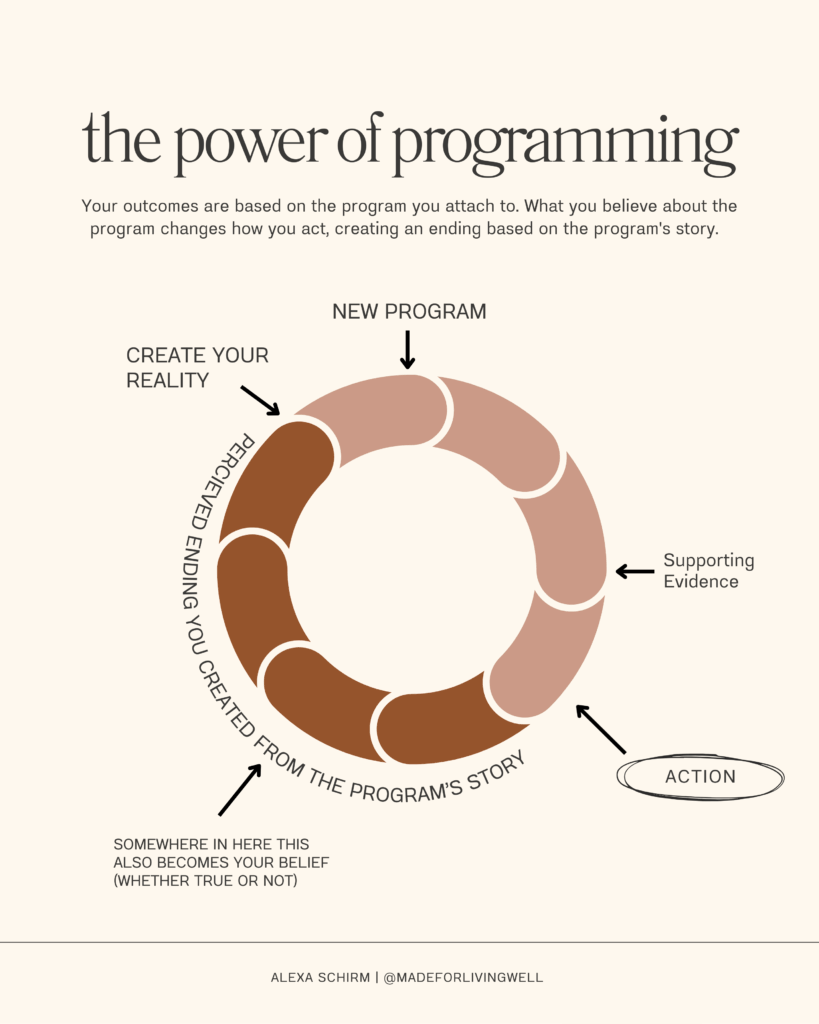
Your mind works the same way. The amount of brain spam you experience is often tied to the programs you’ve signed up for and the beliefs, expectations, and stories you’ve agreed to live under. And I don’t just mean diet programs or therapy plans, but those are very much part of the programming people have adopted.
Humans have established thought patterns early in life, before it was our choice, through the stories told to us, modeled for us, and repeated until they feel like fact.
The programs or thought patterns aren’t inherently bad. We exist on them. The issue is, which ones do you allow to run your life? Be aware of this to change how you think.
Insecure thought patterns harvest your thoughts and feed them back to you through fear, comparison, and big promises that generate more spam. You know the emails that promise the solution to “lose 30 pounds in 3 days.”
This raises the real question: what stories are you believing? What programs are running your life?
Because again, your mind isn’t working off truth. It’s working off familiarity.
Stop Letting Your Mind Decide Your Program.
Before we get into the steps of mental hygiene and cleaning up your mind, it’s important to note that letting your mind decide your thought patterns is essentially letting spam continue to exist.
It’s not to say spam can be gone for good, but you can certainly make spam such a small player in your mind that you don’t even notice it (and most certainly you don’t give it your time or energy). But that means stepping outside your mind and seeing the bigger picture.
Your mind was not meant to act alone but in accordance with your whole, including your body and soul. Your soul is the best source of programming because, while part of you, it is also outside you. It’s attached to the bigger scope of life, your purpose, and connection to the one who made you.
Your soul is the God-space, making it the perfect place to become the program and determine which other programs and systems you allow to run your mind.
Your body is also a great place to evaluate, as it creates your lived experience. It helps you to reframe your thoughts and filter out what is true and what isn’t based on your experience.
All of that to say, don’t spend too much time in your mind or give your mind more power than it deserves. I think we’d all be better off if we unsubscribed to our minds and started subscribing to our souls.
5 Tips For Mental Hygiene
Mental hygiene isn’t about controlling your thoughts. It’s about creating a system that helps you recognize what’s real, what’s helpful, and what’s worth your energy.
Here are a few tips to clean your mind and clear out the brain spam.
01. Subscribe to Your Soul and Body
As mentioned, one of the best ways to clean your mind is to spend more time in your soul and body. They are more trustworthy data sources than your mind. They tell you what feels aligned, safe, grounded, and true, often before your mind catches up.
When you regularly check in with your body and soul, your mind has less authority to run unchecked.
02. Unsubscribe From Fear-Based Programing
Not every thought deserves your attention. Not every belief deserves a seat at the table.
Fear-based programs thrive on urgency, comparison, shame, and scarcity. They often sound convincing because they’re familiar. Not because they’re true.
Unsubscribing means questioning the source. Where did this belief come from? Who benefits if I keep believing it? Does this thought move me toward freedom or further into contraction?
If it leads to panic, self-abandonment, or disconnection, it’s likely spam, and it’s time to unsubscribe.
03. Add Filters
Filters are boundaries for your mind.
This might look like limiting exposure to triggering content, curating who and what you listen to, or creating intentional rhythms around social media, news, or wellness information. It’s being aware and intentional with what you fill your mind with.
Filters also include practices that slow you down, like daily movement, nourishment, prayer, breathwork, and reflection. These help your nervous system regulate itself, allowing your brain to sort information more accurately.
A regulated system filters better. An overwhelmed one lets everything through.
04. Don’t Open What You Aren’t Resourced to Handle
Just because a thought appears doesn’t mean it’s time to engage with it. Like email, opening messages without the intent to address them generally means they linger longer, taking more energy and resources than they are worth.
Again, you need to view your mind through the lens of energy and resourcing. Does your mind have the capacity to handle it now? Likewise, is it worth using energy to hold it until later?
Some emails need to stay unopened until you have the capacity to respond. When you’re tired, hungry, emotionally raw, or overstimulated, your ability to discern truth is compromised. This is not the time to analyze your worth, your body, your future, or your relationships.
Delay is wisdom. You can come back to it later or realize you never needed to open it at all and hit delete.
05. Clean Daily and Weekly
Mental hygiene is ongoing. It’s a daily or weekly process of managing your mind so spam doesn’t accumulate.
Daily cleaning might look like noticing patterns, naming what isn’t true, grounding in your body, or reminding yourself of what is real. Weekly cleaning might mean reflection, therapy, journaling, long walks, prayer, or intentionally disconnecting so your system can reset.
Just don’t wait until your inbox is overflowing to clean it out. Your mind deserves the same care.
Choose To Fill Your Mind Well
If this resonated, this is the kind of work I explore every week inside The Weekly Fill Newsletter. It’s where we talk about mind hygiene, borrowed stories, embodied health, and what it actually looks like to live well without fear running the show.
It’s a slower, more honest space to reconnect with yourself and reset the programs shaping your life. You can sign up to receive it weekly, and if this idea of brain spam and programming hits close to home, I’d especially encourage you to read the latest article on borrowed stories.
Join the healthiest club around and get the free newsletter sent to your inbox weekly. Subscriber here.