





Do you ever feel like the more you know, the worse you are? Like with every podcast episode, every headline, every new study, you somehow end up more confused, more overwhelmed, and farther away from the wellness you were promised? It often feels like information has become more of a burden than a bridge of living.
We live in the age of information overload, where gathering knowledge is valued more than living it. We are taught to consume advice at lightning speed, yet rarely shown how to slow down long enough to process it, or better, pay attention to how it’s landing in our own bodies. Wisdom has been traded for collecting facts, rules, frameworks, and “how-to” plans. Yet, we often lack the one thing that transforms knowledge into wisdom: the lived experience of applying them.
This is exactly why I created my upcoming live class, Uncovering Your Health Blueprint: Building Your Wellness Plan. Not to give you another set of rules to follow, but to help you finally understand your body, your responses, and your unique needs so wellness stops feeling like something you’re chasing and starts feeling like something you’re building. {Join the waitlist here}
Most wellness culture overlooks the distinction between gathering information and living well.
When Knowing More Makes You Feel Worse
We’ve been conditioned to believe that the answer to our health struggles is always “more.” More knowledge, more tracking, more supplements, more discipline, and more plans. But what often happens instead is that the more information we consume, the less confident we feel in that knowledge and in our own bodies.
We end up living in confusion, and here, confusion becomes the culprit of stagnancy.
You might have all the head knowledge about macros, hormones, gut health, and circadian rhythms, but still don’t know what to do because you’ve never been allowed the opportunity to experiment with the knowledge.
Wisdom doesn’t come from knowing what to do. It comes from knowing what happens when you do it. Wisdom is knowledge married to lived experience. Without that lived experience, wellness becomes theoretical, rigid, and oddly disconnected from real life. It becomes a good idea rather than a way of life.
Experience, however, requires something uncomfortable. It requires getting your hands dirty, taking it upon yourself to experiment with what you know, and doing so without expectations (or guarantees). Perhaps hardest of all, it also requires trusting your body.
Trusting Your Body When It Feels Like It’s Failed You
Trusting your body may feel like the hardest thing you have to do. It might even seem impossible. You could likely list all the ways your body has “failed” you. Whether through listing the symptoms or diagnoses you’re plagued with. Or the many weight fluctuations, inflammation, and relentless fatigue you deal with. Or perhaps the greatest offender is the way your body hasn’t responded to what you’ve tried when you followed the plan perfectly.
It’s common to believe your body is the problem. Yet this belief has only perpetuated that idea. What if you shifted that and started to contemplate, what if the failure you experienced wasn’t your body? What if the failure was the systems you’ve been trying to force your body into?
This question alone has the power to change everything. Because when we shift the blame from your body to the approach, you move out of shame and into curiosity.
Your body is not lazy, broken, or working against you. It’s actually working relentlessly on your behalf. You just have to trust it and listen to it, choosing instead to work with it.
And this is where a wellness plan actually matters.
Why You Need a Wellness Plan (And Why You’ve Been Right to Resist One)
At this point, you might be thinking, isn’t a wellness plan just more pressure? Another thing to manage. Another metric to prove the places I’m failing?
Sure, it can be. And at one point, probably was, especially if it was built on control rather than support.
I’ve lived on both extremes. I’ve had seasons of intense obsession, where my entire sense of worth revolved around doing health “right.” Existing within the perfect wellness plan. And I’ve had seasons of avoidance, or what I call my “don’t look, don’t know” era. It was a season when I opted out of structure entirely to recover from burnout. While both seasons taught me something, neither was sustainable.
Here’s what I’ve learned: having no plan can be just as risky as having a plan you obsess over.
The reframe is this: You don’t need a plan because your body is broken. You need a plan because your body deserves consistent support. And having a plan is not jumping on the next trending plan. It’s not just any plan. It’s creating your plan. Your plan is flexible and evolving. One that works for you, not one you have to work for.
This year, my goal is to help you stop living inside someone else’s wellness blueprint and start uncovering your own. {Learn how here}
The bottom line is, you need a plan. We all need a plan to live healthy. Without a plan, you’ll almost always drift towards what is easy (and that is rarely what is healthy).
Remind yourself of this often: the best wellness plan is not about a plan, but creating your plan.
The Problem With Following Someone Else’s Wellness Plan
Most wellness plans are built from someone else’s body, someone else’s biology, someone else’s lifestyle, and someone else’s nervous system. We’re told that if we follow the steps closely enough, such as hitting the protein target or taking this supplement regimen, we’ll get the exact results.
But health doesn’t work like that.
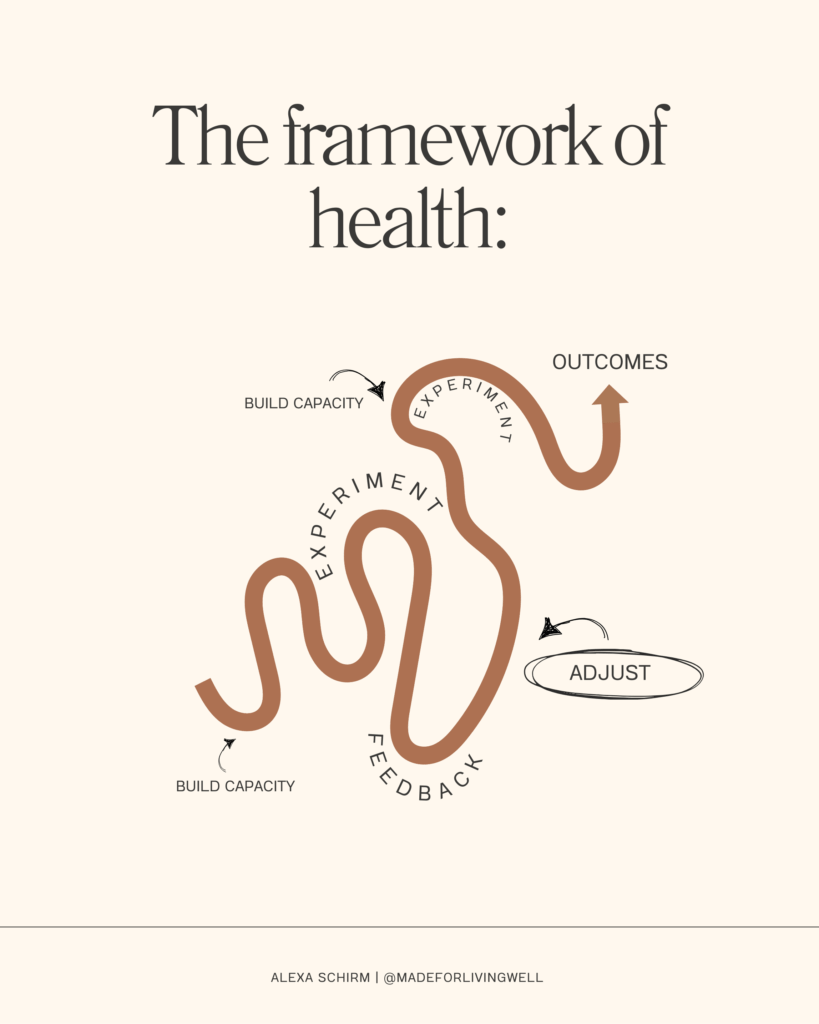
Health is not linear. It doesn’t respond to rules as much as it responds to safety, consistency, and context. Two people can do the exact same thing and experience completely different outcomes. It’s not because one did it wrong, but because their bodies needed something different.
When we ignore this, we end up frustrated, resentful, and often angry at our own bodies. It perpetrates the common cycle, leaving you chasing the next solution, convinced the answer is just one more plan away. But you rarely stop to ask: How am I actually responding to this?
The perfect wellness plan is not perfection. It’s a process. And it begins and ends with how you view your body. Not as a problem to be solved, but as something inherently good. When you recognize your body as good, even when it’s struggling, everything changes. You stop trying to dominate it and start learning from it. You stop outsourcing your health, and you start to create it.
The Five Aspects of a Truly Supportive Wellness Plan
01. It must be Personal.
The first step is perhaps one of the most important. The best wellness plan is 100% personalized to you. That doesn’t mean you don’t learn from other people’s plans. You can and should. You don’t attach yourself to them as a means to an end. Instead, you try it on, see how it fits, learn from it, release what doesn’t belong to you, and keep building until you uncover your way.
Your perfect wellness plan is like a personal brand. It’s layers and styles that accentuate your uniqueness.
02. Keep Things Clean and Tidy (Not Restrictive)
The second thing to note is that building a solid wellness plan isn’t about control. It’s really about reducing unnecessary stress and complexity. It’s about keeping it simple. That means you need to be clear about your plan, your boundaries, your needs, and what you’re not attaching yourself to or picking up.
Your body functions best when it’s not constantly compensating for overload. The simpler you can keep it, the more lasting it will be.
03: It must involve lived action and experimentation
Health is built through doing, not just knowing. Often, the only way to know if it will work for you is to try it and see. Remember, theories are just theories until they’re experienced. Make sure you spend enough time testing something to notice patterns.
Health is really built on the process of trying, observing, adjusting, and trying again. Yet, this is also where most people get stuck. We expect immediate results from action; without them, we become discouraged and quit. But the body doesn’t operate on our preferred timelines. It is driven by safety, consistency, and capacity. You have to try it and then stay in it long enough to know if it’s working.
04: Offer Consistent check-ins
This point produces some ease or trust for the previous one. You need a rhythm of consistent check-ins to help you understand what is working and what isn’t. This information is critical in helping you adjust and adapt.
Now, I’m not talking about obsessive monitoring. They may appear the same on the outside, but internally, the motivation is different. Check-ins are not about judgments. They’re simply about awareness. Use consistent check-ins as a means of understanding what is working and supportive right now and what is depleting.
05: Continuous Refinement & Growth
The truth is, your body is always changing. Rather than viewing that as overwhelming, what if you saw it as an act of freedom? Nothing stays the same, and that means everything has the opportunity to change. Your seasons will shift. A great plan will grow with you. This is where health becomes abundant.
Health Is Personal And That Changes Everything
I’ll state it again, it’s not about finding the perfect plan, but creating your plan. You need a wellness plan, but you need it to work for you, not work for it. Which means it must come from you.
Getting started requires you to understand that health already exists inside you. What you experience externally is a reflection of your internal state. Those actions depend on safety, energy, inputs, the environment, and capacity.
Change is a process of clearing the foundation and building a wellness plan that lasts.
When you think you want another system to follow remember, what you actually want is to feel well. To wake up with energy, feel at home in your body, and live without constant negotiation and self-doubt.
This is what I’ll be teaching inside my upcoming live class, Uncovering Your Health Blueprint: Building Your Wellness Plan. Over the course of this experience, we’ll move beyond information and into integration. You’ll learn how to take what you know, turn it into experimentation, and create a plan your body can actually benefit from
If you’re ready to stop chasing health and start building it your way, I’d love to have you join us. Join the waitlist and learn more here.
The most powerful wellness plan you’ll ever have isn’t someone else’s. It’s the one you learn how to build with your body, not against it.