




It’s easy to look at health from a systematic perspective. It seems best understood through a series of calculations and measurements. Understanding health through a system. But health is not a formula.
Although I certainly carried the same belief. If the right calculation could be created, somehow we’d land on the easy button. We’d find the simple solution the world seemed to be craving when it came to health.
At the same time, the more we’ve traveled in this direction, boxing up health into a series of distinct systems, through calculations and strict science, the more unhealthy we’ve seemed to become.
I’m by no means attempting to devalue the scope of what we know about health and the endless work and energy researchers have invested in fully understanding it. But I do think it’s worthy of looking beyond the scope of the boxes we’ve contained health to — looking in the places we don’t seem to be looking.
There is a lot of work that has already come out in these places. Understanding health from a new perspective. As I study both sides, I am starting to find that it’s not so much that either is wrong, we’ve just missed the point.
Maybe health was never meant to be solved, but rather lived.
Stop solving health and start living it.
Somewhere along the way, we decided that if we could just measure enough, test enough, optimize enough, we’d finally arrive at health. Health was a chase seeking the perfect destination.
At the same time, the more we chase it like a formula, the more elusive it becomes. We’re living, running after something that doesn’t seem to exist.
It’s the ultimate health illusion, chasing a perceived destination the world told you was there, but the more you run, the further it seems, creating this sort of optical illusion, making you and your body the problem.
But if you see it through a different lens, letting go of the idea that health is a fixed state or a destination, you can start to see it’s less about a place and more about a way of being.
Maybe better said, health is a relationship. It is one that asks for participation, interpretation, and even presence. Not to mention, like other relationships, it runs emotionally, seeks validation, and lives for love.
Take a moment to contemplate how this shift would affect you. What if you started treating your health like any other relationship? What would that shift?
The missing link in health
What’s often left out of the health conversations are the things that make us unmistakably human. Our ability to process joy and pain, our belief systems, our creativity, our curiosity, our resiliency, and our capacity to hold and create life. These aren’t side notes to health. They are central to it.
Instead of honoring these differences, we’ve tended to study them only through the lens of perceived weakness. Women are framed as hormonally fragile, emotionally reactive, or physiologically problematic. Men are framed as emotionally disconnected, psychologically rigid, or resistant to vulnerability.
In both cases, the narrative subtly suggests that something is wrong, and the goal becomes to fix it. The goal becomes correction, not understanding.
Over time, this frame of health carries consequences. When health is presented as something external. When something needs to be fixed, managed, or outsourced, we begin to believe that we are the problem. It begins the journey of attempting to fix ourselves or fit into a box. It limits our ability to trust our instincts and instills the belief that the answers we are looking for live somewhere outside of us.
We not only outsource our health but also separate ourselves from it, which, arguably, separates us from life itself.
What we can learn from the placebo effect:
One of the most fascinating things science has ever uncovered about health is the placebo effect. The placebo effect is simply the power of belief in motion. That belief changes biology, alters outcomes, and through that, participation matters.
The placebo effect didn’t expose human weakness. It exposed its sheer power. It showed us that healing is not something that merely happens to us, but something we take part in, something we choose.
This is why I believe health is better understood as an art form than a formula. In our fast-paced, systems-based approach to health, the art of health is something that we’ve lost.
Today, doctors don’t even have to know you. They don’t have to contemplate you or get curious with you. They simply evaluate based on symptoms, which are then used to diagnose. Those symptoms become another box to check, another problem coded for.
Unfortunately, this approach to health misses what is required. It misses the attunement, uniqueness, and the ability to interpret based on the individual. It’s missed the art of understanding. The art of the relationship. It misses the power of your beliefs, your purpose, and how you exist in this life.
Which leaves me to ask a new question. What if you stopped asking, how do I fix myself? And start asking, what is my body trying to tell me?
Health is in you
None of this is to say we should stop trying in health, but it’s rather saying, perhaps the best efforts are not outside of you, but it’s understanding what is happening in you.
I say it repeatedly, “health is not what you do, it’s how your body responds to what you do.”
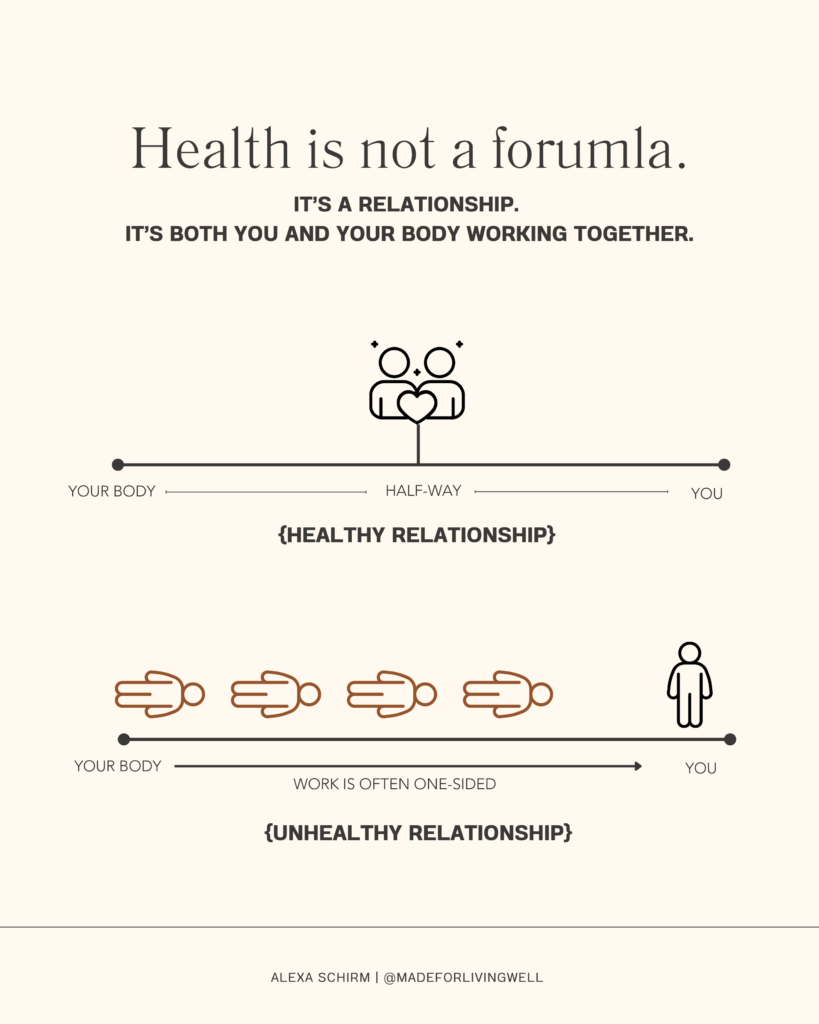
Attempting to find the perfect answer or the one-size-fits-all approach to health greatly diminishes the sheer power and bigness of the human body. It makes health small and, likewise, forces us to live a relatively small and powerless life.
The reality is that health was intended to be your greatest power. To be a force that you carry throughout life.
Health is not alluding you. It’s not escaping you or outside of you. It’s not a process of waiting and working. Health is in you. It is all of you. And yes, there may be things it needs from you — resources, support, nourishment, care — but even those live within your field. They are there ready to be used.
Knowing what you need starts with your relationship with yourself. Not through control, but through connection.
Steps to building a relationship with your health
1. Start by asking different questions.
Instead of “What should I do?” ask, “What am I noticing?”
Instead of “What’s wrong with me?” ask, “What is my body responding to right now?”
2. Track sensation and feelings, not just behavior.
Notice how your body responds to food, movement, rest, stress, and connection. Not just what the plan says should happen.
3. Create space for interpretation.
Pause before reacting. Your body communicates in patterns, not emergencies. Gather the information and signals, and understand the patterns before acting. You do not need to rush.
4. Engage with health daily.
There are a million different ways to engage with your health. Most are small. Maybe it is a series of deep breaths, or a walk without distraction. Maybe it’s a quick check-in. Don’t limit health, but be consistent with it.
5. Rebuild trust (this is vital)
Each time you listen and respond with care, you restore trust between you and your body. That trust is healing in itself.
Remember: Health doesn’t need to be chased. It needs to be understood and supported.
And like all meaningful relationships, it grows when you show up not to fix it, but to understand it.
How is your relationship with yourself?