



How would you define health?
I’ve long thought the current definition of health, created by the World Health Organization, is part of why health has become so elusive. It states health is “a state of complete physical, mental, and social well-being and not merely the absence of disease or infirmity.”
Health, based on this definition, has become a state, or a place you arrive. But this is really an illusion. Leaving people to chase a place or a destination that doesn’t really exist. Of course, it’s easier said than done to define health.
In fact, there are endless depictions of what health is supposed to look like. Entire industries, research bodies, and institutions have attempted to define it and then sell it back to us. Yet, even with all that effort, there is still an acknowledgement that the current definition of health doesn’t capture what it actually is and might be leading people astray.
How does one define health?
Defining health feels strangely difficult. Not because it’s elusive or out of reach, but because health and the definition of health are always changing, or at least how you experience it. I don’t mean this as something unattainable, like a dog chasing a carrot, it’s always just out of reach. I mean it in a lived, embodied sense.
How one person defines health will differ from another’s, and even for the individual, that definition will look different in different seasons of life. It’s always changing, making it difficult to define.
For example, health during pregnancy is not, nor should it be, defined the same way as health when you’re not pregnant. Just like health for a teenager will look different than health for someone in midlife. A man’s health should be expressed differently from a woman’s. And even health during grief, healing, or stress can take on a unique expression.
This doesn’t mean health is vague or meaningless. It just means it’s contextual.
Which is why, rather than trying to force a singular definition of health, we need to re-evaluate our view of it. Because truthfully, health is always present. It’s not a place you arrive or a destination you seek, but it’s you. The difference in how it’s lived isn’t a state but an expression.
Health is you and you are health.
To fully understand this, you have to have a reckoning with yourself.
You have to see health not as something outside you, but as something within you. It’s part of you. And that means deconstructing the common narratives and beliefs.
I know common knowledge has led you to believe that health is outside of you. But, it’s not. It’s not a place you arrive or a set of rules you follow. It’s the opposite. It is you, and it’s always been you. The difference is how you are expressing it.
I don’t mean that in a sense you’ve always expressed it in the best ways. I mean that you have always been a living system, made up of cells, tissues, organs, hormones, and neural pathways, that are constantly responding, adapting, and adjusting to keep you alive based on the circumstances you’re in.
In a simplistic way, you are an expression of “health” because you are a compilation of cells that are working every second of every day on your behalf to help you to exist and, more importantly, live.
Your body was created in health, for health. That’s why health doesn’t disappear. It doesn’t elude you or leave you. It changes not because you have it or don’t, but simply because of a shift in how it’s expressed.
How are you expressing health?
So the question can no longer be, “How do I get healthy?” Because you already are. The question becomes, “How can I change the expression of health so that it supports the way I was designed to live and the way I desire to live?”
When health is no longer a chase, something interesting happens. You lose the excuse.
There is no victim here. It’s all responsibility. Not the kind rooted in blame or perfectionism, but the kind rooted in action. And that means, health isn’t something you find. It’s something you choose. How you choose to live changes its expression.
Health exists on a spectrum
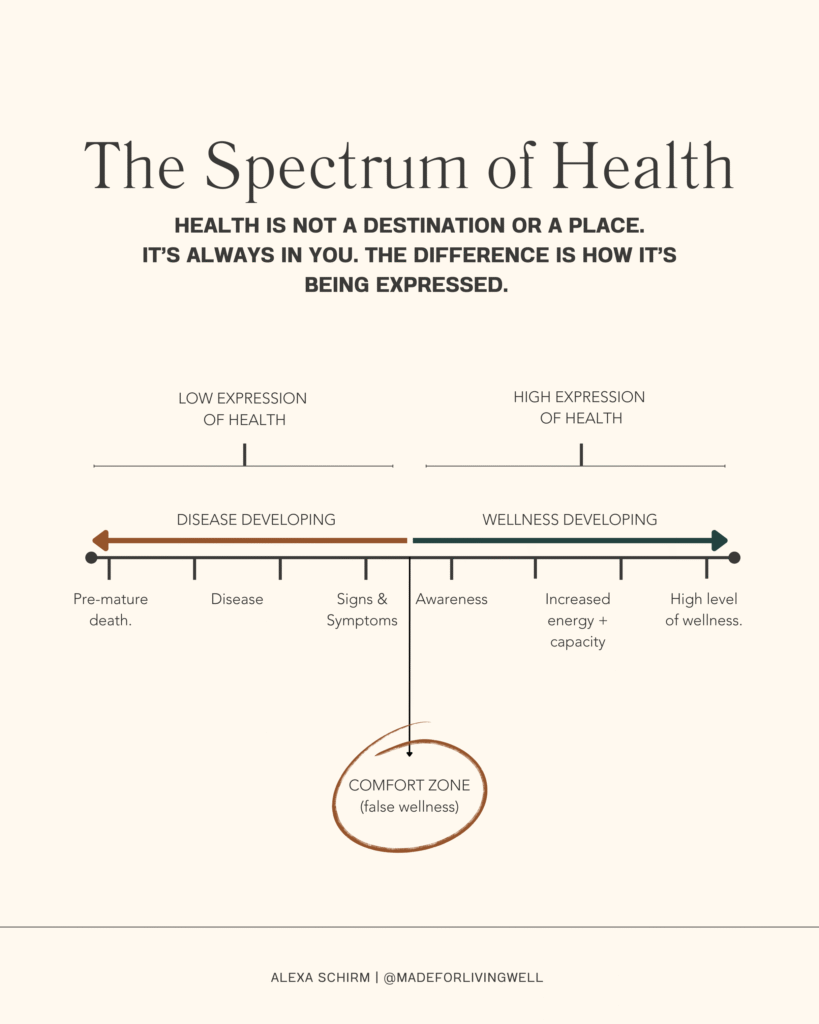
Now that we cleared that up, it’s easier to see health not as an arrival, but as a spectrum. It always is and has been, even if (and when) the expression changes.
What most people consider unhealthy is not the absence of health at all but rather a low expression of it. The body is still functioning in health, but it’s expressing itself in a way that feels restrictive, heavy, or unsupportive.
The low expression of health
The low expression of health indicates that the body is coping or compensating. This happens when the body is under-resourced and under-supported, creating an environment where it’s just trying to survive.
This could look like:
- Functioning, but with constant friction.
- Surviving, and in the process creating more isolated systems.
- Needing a lot of effort to just feel “normal.”
- The body war, where it feels like your body is against you, and you against your body.
- Working incredibly hard while seeing little or no return.
Common Signs of the low expression of health:
- Not feeling well, even if nothing is “wrong” on paper.
- Chronic fatigue or low-grade exhaustion.
- Relying heavily on external sources to fix or override the body.
- Feeling disconnected from your body and ignoring its signals.
- Body resentment or body hate.
- A sense that everything feels like work.
The key thing to remember is this: even in this low expression, your body is still working in health. It’s doing the best it can with what it has. It may not feel good, but it is still working on your behalf.
The High expression of health
On the flip side of the spectrum is the high expression of health. This is where the body has capacity. It’s not a metric of perfection or the absence of challenge or stress. It’s a state where the body has enough internal resources to respond, recover, and engage in life. The high expression of health is a state of thriving. It’s a place of freedom.
This could look like:
- Energy that feels steady rather than forced.
- An ease about daily life.
- A sense of internal safety and trust with your body.
- A deeper awareness of physical and emotional signals.
Common signs of the high expression of health:
- Emotional regulation and resilience.
- Stable, consistent energy.
- Supportive digestion, sleep, and hormonal balance.
- Flexibility. You can handle stress, travel, missed workouts, or indulgent meals because they’re balanced by recovery and nourishment.
- A felt sense of connection to your body and to others.
- Health that supports your life instead of consuming it.
Essentially, your body has a buffer.
Health is not a pass or fail system
Most wellness advice focuses on inputs like eat this, don’t eat that, follow these rules, and give up that. While some of these inputs can influence the expression of health, viewing health as black and white and pass or fail keeps health focused on something that doesn’t actually exist.
If you’ve ever felt like the chase of health never ends, it’s because it doesn’t. You’re chasing an illusion that doesn’t exist.
Health isn’t a chase or a finish line. It’s a way of living.
Understanding health as a spectrum gives you something far more powerful than rules. It gives you full responsibility to shift it. It gives you agency over your health. Health is something you can influence, regardless of your environment, socioeconomic status, or even genetics. Not because these factors don’t matter, but because your daily choices shape the expression more.
Shifting the expression is about output.
Shifting how you express health is about output. It’s how you feel living your life. It’s how you respond to stress, change, grief, joy, and unpredictability. It’s how you recover. It’s about how you show up and how you choose to live. And truthfully, only you can know that.
When you release the black-and-white thinking and the all-or-nothing mentality, you create space to build capacity rather than chase control. Health becomes a creation.
That’s why, if I had the opportunity to redefine health, I’d definitely say: Health is the capacity to live your life with resilience, energy, and adaptability. Not the absence of symptoms or the presence of perfect habits.
This definition leaves room for being human. And this is where compassion enters the conversation.
Leave room for compassion.
When health is viewed as an expression, it removes shame from the room. It allows you to see your current state not as a failure, but as information. A signal. A snapshot of how supported or unsupported your system is right now. Nothing more and nothing less.
The low expression of health isn’t a moral flaw. It isn’t proof that you didn’t try hard enough or want it badly enough. It’s simply feedback that something needs attention, whether that is more rest, more nourishment, more safety, more honesty, more margin, or simply less pressure.
The high expression of health doesn’t come from dominating the body, but from partnering with it. It comes from listening instead of overriding. From responding instead of reacting, and from choosing rhythms that build capacity rather than constantly deplete it.
Health is personal.
This also means health will never look identical between two people, even if they follow the same habits. Because bodies are different. Lives are different. Nervous systems, histories, seasons, and responsibilities are all different. Expression is personal.
Perhaps that’s the most freeing part of this perspective. You no longer need to compare your health to someone else’s. You only need to ask whether your current expression is supporting the life you’re trying to live.
Health becomes less about optimization and more about alignment. Less about control and more about the relationship. Less about chasing an ideal and more about inhabiting your actual life with intention.
So maybe the question isn’t, “Am I healthy or not?”
Maybe the better question is, “What is my body expressing right now, and what would help it express more life?”
That’s a question you can return to again and again. In every season. In every version of yourself. And it will never lead you away from your body. Only deeper into a relationship with it.